
You have already done the reading. You know roughly how grafts work. You have a sense of how many you might need. You have probably looked at a few clinics online. Understanding hair transplant cost in India is the easy part, most clinics will give you a number quickly.
What you have not yet found is a clear answer to the harder question. How do you choose safely in a market with conflicting information? That is what this guide is for. It will not tell you whether a hair transplant is right for you. That question is settled. What it will do is walk you through how to make this decision without being misled, overcharged, or ending up with a result that needs correcting.
India has some of the most qualified hair restoration surgeons in the world. It also has a significant number of clinics where the operating doctor does not hold the necessary qualifications. Knowing the difference before you book a consultation is the entire point of this guide.
Costacea is an independent clinic directory and cost comparison resource. We do not book appointments, accept clinic payments, or rank providers. Every clinic in our network has been verified against a fixed credential standard.
This guide explains what that standard is and how you can apply it yourself.
Why This Decision Is Harder Than It Looks
Hair transplant surgery in India is not a tightly regulated procedure. Any registered medical practitioner can legally perform it. This has created a wide gap between the best and worst providers.
According to the ISHRS 2025 Practice Census, 59% of hair restoration surgeons globally reported black-market clinics operating in their cities. Repair procedures rose to 6.9% of all hair transplants in 2024, up from 5.4% in 2021.
One in every fourteen hair transplants performed in 2024 was a repair of a previous procedure. Many of those patients paid twice. Once for a poor result, and once for correction.
Social media advertising makes this harder to navigate. Clinics running before-and-after campaigns are not required to name the operating doctor. Heavily discounted pricing is often a signal. It frequently indicates that the doctor whose name appears on the website is not performing the procedure.
The market is not uniformly bad. But it requires more scrutiny than most cosmetic procedures. This guide gives you the tools for that scrutiny.
What a Safe Hair Transplant Decision Actually Looks Like
A good outcome starts before the procedure. These steps consistently separate successful cases from those requiring correction.
Step 1: Confirm your hair loss has stabilised
A transplant performed on active, progressive hair loss may produce poor density within a few years. A dermatologist can assess this before you commit to surgery.
Step 2: Identify the operating doctor before the consultation
Ask directly: which doctor will perform the extraction and the implantation? The answer must be a named individual with verifiable credentials. “Our experienced team” is not an answer.
Step 3: Verify credentials independently
The minimum qualification for a doctor performing hair transplant surgery is MD Dermatology, DNB Dermatology, or MCh Plastic Surgery. Check the NMC registration database. Do not rely on clinic marketing alone.
Step 4: Attend a full consultation before committing
A proper consultation includes a physical scalp examination, a graft estimate with reasoning, and a written cost breakdown. A clinic that quotes a price before examining your scalp has not assessed you properly.
Step 5: Review the quote in full before agreeing.
Ask what is included and what is not. PRP, medications, blood tests, and follow-up visits are frequently charged separately. Request an itemised breakdown in writing.
Understanding Cost: What It Actually Tells You
Hair transplant pricing in India is calculated per graft. A graft is a natural cluster of one to four hair follicles. The total cost is the per-graft rate multiplied by the grafts your case requires.
Most verified clinics in India charge between ₹40 and ₹120 per graft. This depends on the city, the surgeon, and the clinic tier. The table below shows approximate total costs by graft count across city tiers.
| Grafts | Metro Cities (Delhi, Mumbai, Bangalore) | Mid-Tier Cities (Chandigarh, Pune, Jaipur) | Smaller Cities |
| 1,000 | ₹60,000 – ₹80,000 | ₹40,000 – ₹60,000 | ₹25,000 – ₹40,000 |
| 2,000 | ₹1,00,000 – ₹1,30,000 | ₹70,000 – ₹1,00,000 | ₹45,000 – ₹65,000 |
| 3,000 | ₹1,30,000 – ₹1,50,000 | ₹90,000 – ₹1,20,000 | ₹60,000 – ₹80,000 |
Use our Hair Transplant Cost Calculator for a personalised estimate. All figures are estimates based on verified, surgeon-led procedures. Actual pricing depends on your consultation.
A quote significantly below these ranges is not a reason to be encouraged. It is a reason to ask more questions. Such quotes often reflect technician-led procedures, shared operating time, or a doctor whose qualifications fall below the standard. A corrective procedure significantly increases the total cost of treatment, and may not always be possible depending on remaining donor availability.
For city-specific pricing verified against individual clinics, browse our full city guide network below.
How Many Grafts Do You Need?
Graft requirements depend on the extent and pattern of your hair loss. The table below provides general estimates based on common hair loss patterns.
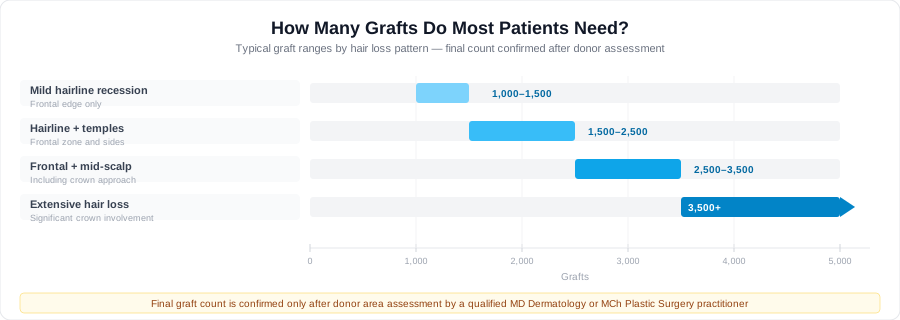
These are general estimates only. Only a physical scalp assessment by a qualified surgeon can determine your actual graft requirement. Do not rely on self-assessment or clinic estimates made from photographs.
A donor area assessment is equally important. Even if your hair loss pattern suggests a certain graft count, your donor supply may limit what is achievable in a single session. A good surgeon raises this unprompted.
What Qualifies a Doctor to Perform This Procedure
Hair transplant surgery in India is most appropriately performed by postgraduate specialists in dermatology or plastic surgery. The minimum qualification Costacea accepts for a listed doctor is one of the following:
- MD Dermatology
- DNB Dermatology
- MCh Plastic Surgery
These represent formal postgraduate training through a recognised Indian medical institution.
Several other qualifications appear frequently in clinic marketing. They do not meet this standard. MBBS alone is not sufficient. DNB Plastic Surgery is not equivalent to MCh Plastic Surgery for this purpose. Fellowship certificates from private training institutes are not equivalent to postgraduate medical degrees.
This does not mean every doctor with the above qualifications is equally skilled. It means that without one of these credentials, the doctor has not completed the postgraduate training that the procedure requires.
How to verify
Search the National Medical Commission register by doctor name. The register is publicly accessible at nmc.org.in. It confirms the registered degree and the institution. If a clinic is unwilling to name the operating doctor, leave.
Red Flags to Watch For
These are specific signs that a clinic may not meet basic safety standards.
The operating doctor is not named
Reputable clinics name the doctor performing the procedure. Vague references to “our team” or “our experts” are not sufficient. Ask directly before agreeing to any consultation.
The quote is given before a scalp examination
Graft count and cost cannot be determined without assessing donor density and scalp condition. A quote given over the phone or from a photograph is not a clinical assessment.
The clinic promotes techniques that are not clinically defined
Terms such as Bio FUE, DHT hair transplant, and similar branded variants are marketing labels. They are not recognised surgical techniques with distinct clinical definitions. FUE and FUT are the two established methods. Any clinic that builds its pitch around trademarked variants deserves close questioning.
Guaranteed results are promised
No qualified surgeon guarantees specific outcomes. Graft survival depends on individual biology, donor quality, and post-operative care. A claim of “100% growth” or “full coverage guaranteed” is not a clinical statement.
Pressure to book quickly
A time-limited discount or urgency to confirm before a full consultation is complete is a commercial tactic. It is not in your interest.
The procedure is not performed in a registered medical facility
Clinical procedures must be conducted in a registered establishment. Ask for registration details. In India, clinical establishments are registered under the Clinical Establishments Act or equivalent state legislation.
What a Good Consultation Should Include
A consultation is your opportunity to assess the clinic, not just the other way around. A thorough pre-procedure consultation should cover the following.
Physical scalp examination
The doctor should examine your donor area density, scalp laxity, and current hair loss pattern. This cannot be done remotely or from photographs.
A Norwood scale assessment
This is the standard framework for classifying hair loss stage and pattern. Your grade should be communicated and explained to you clearly.
A graft estimate with reasoning
The doctor should explain how many grafts they recommend, why, and what coverage is expected. An estimate without an explanation is not sufficient.
An honest prognosis on native hair
If your remaining hair continues to thin, the transplant may need future revision. A reputable surgeon raises this unprompted.
A written cost breakdown
Request this in writing before you leave. It should itemise the procedure cost, the per-graft rate, and any additional charges. PRP, blood tests, medications, and follow-up visits are frequently charged separately.
Questions to Ask Before You Commit
These questions are for patients close to choosing a clinic. They are more pointed than the general questions you will find on most sites.
- Which doctor will personally perform the extraction and the implantation?
- What are that doctor’s postgraduate qualifications and NMC registration number?
- How many procedures has that doctor personally performed, not the clinic collectively?
- Can I see before-and-after cases from patients with a similar hair loss pattern to mine?
- What graft survival rate do you typically achieve, and how do you measure it?
- What is included in the quoted price, and what will be charged separately?
- What is your process if the result is unsatisfactory after twelve months?
- Will you provide a written treatment plan and cost breakdown before I confirm?
A clinic that is evasive or dismissive on any of these questions is telling you something useful.
Finding a Clinic: Browse by City
Costacea lists verified clinics across all major cities in India. Every clinic in our directory has been reviewed against our fixed credential standard. We check each clinic’s official website, identify the doctor responsible for performing procedures, verify their postgraduate qualifications, and list only those who meet our minimum credential requirement.
We do not rank clinics, accept payment for placement, or allow referral relationships to influence listings. Our editorial process is independent of the clinics we list.
How Costacea Estimates Pricing and Verifies Clinics
Costacea compiles pricing estimates by reviewing published information from verified clinics across each city we cover. We cross-reference against regional market data and published clinic fee structures. All estimates reflect typical ranges for verified, surgeon-led procedures. They do not include technician-led or budget clinics that fall below our credential standard.
Clinic verification follows a fixed process. We review each clinic’s official website and identify the doctor responsible for performing procedures. We then verify their postgraduate qualifications against our credential criteria. Only clinics where the operating doctor holds MD Dermatology, DNB Dermatology, or MCh Plastic Surgery are listed. We do not accept payment for placement or offer preferential listings.
All pricing information is provided for educational purposes only. Actual costs vary based on individual clinical assessment, graft requirements, and clinic-specific factors. Consult a qualified surgeon for a personalised estimate.
Costacea editorial team. Last updated July 2026.
Related Guides
FUE vs FUT Hair Transplant: Which Is Right for You?
A detailed comparison of the two established techniques. How they differ in scarring, recovery, graft yield, and cost, and what to ask your surgeon before accepting a recommendation.
Hair Transplant Recovery Timeline: What to Expect Week by Week
A week-by-week breakdown of physical healing and hair growth, including the shedding phase, what is normal, and when to contact your surgeon.
Frequently Asked Questions
What is the cost of a hair transplant in India?
Hair transplant costs in India vary by city tier, clinic, and graft count. Most verified clinics in metro cities charge between ₹60,000 and ₹1,50,000 for a typical 2,000–3,000 graft procedure. Mid-tier cities generally range from ₹70,000 to ₹1,20,000 for a comparable procedure. Per-graft rates typically fall between ₹40 and ₹120 at verified, surgeon-led clinics. Pricing significantly outside this range on either end warrants close scrutiny. Use our city guides for location-specific estimates verified against listed clinics.
Is hair transplant safe in India?
Hair transplant surgery is safe when performed by a qualified surgeon in a registered medical facility. The risk comes from the significant number of clinics in India where the operating doctor does not hold the necessary postgraduate qualifications. Always verify the operating doctor holds MD Dermatology, DNB Dermatology, or MCh Plastic Surgery, and confirm they will personally perform the extraction and implantation rather than delegating to unqualified staff. A clinic that is transparent about these details is a clinic worth considering.
Who is qualified to perform a hair transplant in India?
The minimum qualification Costacea accepts for a listed doctor is MD Dermatology, DNB Dermatology, or MCh Plastic Surgery. These represent formal postgraduate training through a recognised Indian medical institution. MBBS alone does not meet this standard. Always ask the clinic which doctor will perform your procedure and verify their credentials on the NMC register before booking a consultation.
What is the difference between FUE and FUT?
FUE, or Follicular Unit Extraction, involves removing individual follicular units directly from the donor area using a small punch instrument. There is no linear scar and recovery is generally faster. FUT, or Follicular Unit Transplantation, involves removing a strip of scalp from the donor area. Follicular units are then dissected from this strip and implanted. FUT leaves a linear scar but may allow a higher graft count in a single session. The appropriate technique depends on your hair loss pattern, donor density, and your surgeon’s assessment.
How many grafts will I need?
Graft requirements depend on the extent and pattern of your hair loss. A mild hairline recession typically requires 1,000–1,500 grafts. Hairline and temple restoration may need 1,500–2,500 grafts. Frontal and mid-scalp coverage usually requires 2,500–3,500 grafts. Extensive hair loss may need 3,500 or more. Only a physical scalp assessment by a qualified surgeon can determine your actual requirement. Do not rely on self-assessment for this.
How do I verify a doctor’s credentials in India?
Search the National Medical Commission register by doctor name at nmc.org.in. The register confirms the degree held and the institution that awarded it. This takes less than five minutes. If a clinic is unwilling to name the doctor who will perform your procedure, treat that as a warning sign.
Are the results permanent?
Transplanted follicles are taken from the donor area at the back and sides of the scalp. These follicles are genetically resistant to the hormone responsible for pattern hair loss. Once established, they grow for life. However, native hair may continue to thin over time. Density can appear to reduce in untreated areas years after the procedure. A reputable surgeon discusses this candidly during consultation.
What should I expect during recovery?
Small scabs form at the transplanted area within the first few days and typically shed within ten to fourteen days. Mild swelling around the forehead and eyes is common in the first three to five days. Most patients return to desk work within five to seven days. Strenuous activity should be avoided for two to four weeks. Transplanted hair sheds in the first four to eight weeks; this is a normal part of the cycle and does not indicate failure. Visible new growth typically begins at three to four months. Full results are visible at ten to twelve months.
Can women undergo hair transplantation?
Women with stable hair loss, adequate donor density, and realistic expectations are suitable candidates. Female hair loss often presents as diffuse thinning rather than defined bald patches. This affects hairline design and graft distribution planning. Ask whether the surgeon has specific experience with female hair restoration. Not all clinics do, and the approach differs from male pattern cases.
Is PRP included in the procedure cost?
PRP, or platelet-rich plasma therapy, is frequently offered alongside hair transplant surgery. It is not a standard inclusion. Most clinics charge for it separately, typically between ₹3,000 and ₹10,000 per session. Confirm in writing what is and is not included in the quoted price before agreeing to any procedure. Request an itemised breakdown.
What happens if I am not satisfied with the result?
Dissatisfaction typically falls into two categories: incomplete coverage due to lower than expected graft survival, or aesthetic concerns about hairline design or density. Raise concerns at the twelve-month mark, when results are considered final. Reputable clinics review outcomes and discuss options. If the issue stems from a substandard procedure, a revision transplant from a different qualified surgeon may be possible, depending on remaining donor availability. This is why choosing correctly the first time matters.
How do I know if a clinic is operating safely?
A safe clinic is registered under the Clinical Establishments Act or equivalent state legislation. The operating doctor holds a verifiable postgraduate qualification. The facility uses sterile, single-use instruments. The doctor performs extraction and implantation personally, rather than delegating to unqualified staff. If a clinic is unwilling to answer these questions directly, seek a consultation elsewhere.
Why are some clinics so much cheaper than others?
Pricing differences reflect differences in what is actually being offered. A lower per-graft rate may indicate that the procedure is performed by a technician rather than a qualified surgeon. It may reflect older equipment, limited follow-up, or a shorter procedure time that affects graft survival. It may also simply reflect a less experienced surgeon or a lower-cost city. Very low pricing is not automatically a warning sign, but it is a prompt to ask more questions before committing.