
Most patients arrive at this question having already decided on surgery. They want to understand what their surgeon has recommended, or why one hair transplant technique was suggested over another.
The FUE vs FUT hair transplant debate is one of the most common questions patients bring to their first consultation. Both are established, peer-reviewed surgical techniques. Both produce permanent results when performed correctly by a qualified surgeon. The clinical literature does not support a blanket claim that either technique is universally superior. The choice between them depends on clinical factors specific to each patient.
This guide explains how each technique works, what the evidence shows about long-term outcomes, and what questions to ask before accepting a technique recommendation.
How FUE Works
Follicular Unit Extraction involves removing individual follicular units from the donor area. A small circular punch instrument scores and extracts each unit separately. No linear incision is made at any point during the procedure.
The extracted units are implanted into the recipient area through small incisions. The procedure is performed under local anaesthesia. A session of 2,000 to 3,500 grafts typically takes six to ten hours.
The donor area heals with small circular punctate scars distributed across the extraction zone. At typical hair lengths, these are generally not visible to the naked eye. Recovery is faster than FUT. Most patients return to normal activity within five to seven days.
How FUT Works
Follicular Unit Transplantation is also called the strip method. It involves removing a strip of scalp skin from the donor area, typically from the occipital region. The donor site is then closed with sutures or staples.
The excised strip is dissected under magnification by a trained surgical team. Individual follicular units are isolated and prepared for implantation. These grafts are placed into the recipient area in the same manner as FUE.
FUT leaves a linear scar at the donor site. Scar visibility depends on closure technique, scalp laxity, and the length at which the patient wears their hair. In patients who keep their hair short, the scar may be visible. FUT recovery typically takes ten to fourteen days. Sutures are removed at this point.
The strip method allows a higher graft count in a single session. Patients requiring 4,000 or more grafts in one procedure are often better suited to FUT. A combination of FUT and FUE across sessions is also an option for high-grade cases.
FUE vs FUT Hair Transplant: Side by Side Comparison
The table below summarises the key clinical and practical differences between FUE and FUT. Use it as a reference point alongside your surgeon’s recommendation.
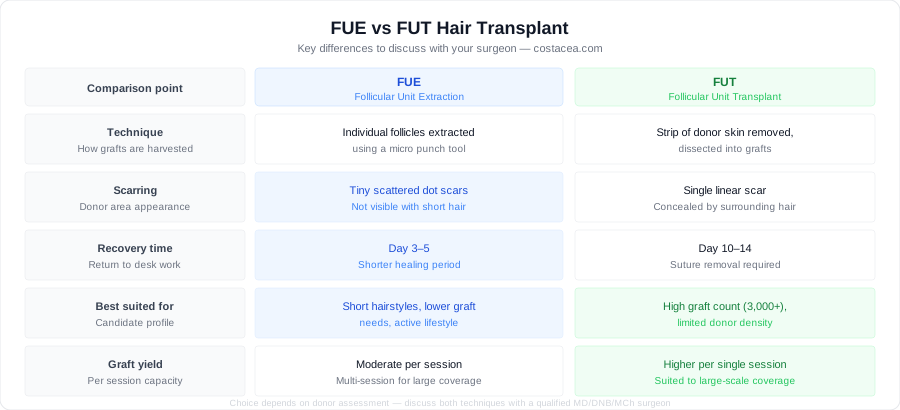
Graft counts depend on donor density and scalp laxity assessed at consultation. Use our Hair Transplant Cost Calculator for a personalised estimate.
When FUE Is the More Appropriate Choice
These are the clinical and practical factors that typically point toward FUE. Your surgeon should be able to explain which of these apply to your specific case.
- Lower graft requirements: For patients requiring fewer than 3,000 grafts in a single session, FUE is well suited. Procedure time is manageable and donor area recovery is predictable.
- Preference for shorter hairstyles: FUE leaves no linear scar. Patients who wear their hair short or shaved will not have a visible donor scar following the procedure.
- Limited scalp laxity: FUT requires sufficient scalp laxity to close the donor site without excessive tension. Patients with tight scalps are generally better candidates for FUE.
- Faster return to activity: FUE recovery is approximately half the time of FUT. This may be relevant for patients with occupational or lifestyle constraints.
When FUT Is the More Appropriate Choice
These are the clinical and practical factors that typically point toward FUT. As with FUE, the decision should follow a direct assessment of your scalp rather than a generalised preference.
- High graft requirement in a single session: FUT allows extraction of a higher graft count in one procedure. For patients with Norwood Grade 5 or above, this clinical advantage is meaningful.
- Adequate scalp laxity: Patients with good scalp laxity are better candidates for the strip procedure. Less tension on the donor closure produces a finer scar.
- Cost is a primary consideration: FUT carries a lower per-graft cost than FUE. For patients requiring a large number of grafts, this difference is financially significant.
- Preservation of the FUE donor zone: Some surgeons recommend FUT for a first procedure. This preserves the FUE donor zone for future sessions if native hair loss continues to progress.
What the Clinical Evidence Shows
The clinical literature consistently supports both FUE and FUT as effective techniques for androgenetic alopecia. Direct comparative data on long-term outcomes is limited but informative.
A four-year follow-up study of 112 male FUT patients found that long-term density maintenance varied considerably. Published in the Journal of Cutaneous and Aesthetic Surgery, the study compared results at one year and four years post-procedure in patients with Norwood Grade 4 and above. At the four-year mark, 55.35% showed moderate reduction in transplanted hair density. Only 8.92% maintained stable density throughout that period.
This does not indicate that FUT produces poor outcomes. It indicates that long-term density is influenced by the continued progression of androgenetic alopecia in native hair. The same principle applies to FUE outcomes. Transplanted follicles are permanent; the native hair around them is not.
A separate PMC clinical outcomes study found that 86% of FUE patients rated their results as excellent at follow-up. Both figures reflect outcomes under qualified surgical care.
Taken together, the evidence supports one central conclusion: long-term density maintenance requires managing native hair loss alongside the transplant. This typically involves finasteride, minoxidil, or both. A surgeon who does not raise this during consultation has left out a significant part of the plan.
The strongest predictor of outcomes is not the technique. It is the experience and skill of the operating surgeon.
Questions to Ask Your Surgeon About Technique
A technique recommendation should be based on your specific clinical profile. These questions will help you understand the reasoning behind it.
- Based on my donor density and scalp laxity, why is this technique appropriate for my case?
- What graft count do you anticipate, and does this influence the technique selection?
- If FUT is recommended, what is your closure technique? What will the scar look like at my typical hair length?
- If FUE is recommended, how will you distribute extraction to avoid visible thinning of the donor zone?
- Do you personally perform both the extraction and the implantation, or is any part delegated?
- How does your recommendation change if I require a second session in future?
- What medical management do you recommend alongside the procedure to protect long-term density?
- Can you show me long-term follow-up cases, at two years or more, from patients with a similar loss pattern to mine?
How Technique Affects Cost in India
FUE typically costs more per graft than FUT across all city tiers in India. The difference reflects the additional operative time that individual follicle extraction requires.
At verified, surgeon-led clinics in India, FUE per-graft rates are generally 15 to 30% higher than FUT at the same facility. For a procedure of 2,500 grafts, this difference may amount to ₹15,000 to ₹40,000 depending on the city and clinic.
Cost should not be the primary factor in technique selection. Choosing FUT solely on cost grounds, without clinical justification, may not produce the best outcome for your case. Technique selection should follow the surgeon’s clinical assessment of your scalp, not the pricing sheet.
For surgeon-specific technique recommendations in major cities, see our guides for Delhi, Mumbai, Bangalore, and Hyderabad. For a national pricing overview, see the Hair Transplant Cost in India guide.
How Costacea Lists Techniques
Costacea lists clinics where the operating doctor performs FUE, FUT, or both. These are the two clinically established techniques for hair transplantation, supported by published peer-reviewed evidence. For reference on how the International Society of Hair Restoration Surgery defines and positions these techniques, see ishrs.org.
We do not list clinics that market procedures exclusively under branded or proprietary names, such as Bio FUE, DHT hair transplant, or similar variants, without a clear underlying FUE or FUT description. These labels are not recognised in the peer-reviewed literature as distinct surgical techniques. They are marketing designations applied to modifications of standard FUE.
This does not mean all clinics using such labels deliver poor outcomes. It means the technique claim cannot be independently verified or benchmarked against published clinical standards. When assessing any clinic’s technique claims, identify the underlying procedure, FUE or FUT, and focus on the credentials of the operating doctor.
Related Guides
Hair Transplant Cost in India: Complete Guide
National overview of pricing, credential standards, red flags to watch for, and verified clinic listings across 40 cities.
Hair Transplant Recovery Timeline: What to Expect Week by Week
Once technique is decided, this guide walks through what happens at each stage of physical healing and hair growth.
Frequently Asked Questions
Is FUE better than FUT?
Neither technique is universally superior. FUE avoids a linear scar and has a faster recovery timeline. FUT allows a higher graft count per session and typically costs less per graft. The appropriate choice depends on graft requirement, scalp laxity, hair length preference, and the surgeon’s clinical assessment. Defaulting to FUE without considering these factors does not always produce the best outcome. The technique should follow the case, not the other way around.
Which technique leaves less scarring?
FUE leaves small diffuse circular scars across the extraction zone. These are generally not visible at typical hair lengths. FUT leaves a single linear scar at the donor site. Visibility depends on closure technique, scalp laxity, and the length at which you wear your hair. Neither technique is scarless. Any incision into the dermis produces scar tissue. The relevant question is not whether scarring occurs, but whether it will be visible at your preferred hair length.
Which technique has a faster recovery time?
FUE recovery is faster. Most patients return to routine activities within five to seven days. The donor area heals without sutures, and visible scabbing resolves within ten to fourteen days. FUT recovery takes ten to fourteen days before suture removal, with full donor healing taking several weeks beyond that. If minimising downtime is a priority, FUE is the more practical option, though the technique selection should ultimately follow clinical factors rather than recovery preference alone.
Can FUE and FUT be combined?
A combined approach is appropriate for patients requiring a very high graft count across multiple sessions. FUT may be used in a first session to preserve the FUE donor zone for later use. The decision should follow a clinical assessment of donor density, scalp laxity, and total graft requirement. Not all surgeons perform both techniques. Confirm this explicitly before booking.
Does technique affect graft survival?
Graft survival is influenced more by surgical execution than by the choice of FUE versus FUT. Transection rate during extraction, graft handling, out-of-body time, and implantation precision all affect survival. These factors are primarily determined by surgical skill. Long-term density is also affected by the continued progression of native hair loss in untreated areas. Both techniques produce comparable graft survival under qualified surgical care.
Is FUE more painful than FUT?
Both procedures are performed under local anaesthesia. Neither should be painful during surgery. Most patients report discomfort during the anaesthetic injection rather than during the extraction or implantation stages. Post-procedure, FUT patients typically experience more soreness at the donor site due to the linear incision and sutures. FUE patients report milder post-procedure discomfort overall. Pain management with standard prescribed medication is usually sufficient for both techniques.
Which technique is better for women?
FUT is sometimes preferred for female patients. Women typically do not shave the donor area, making the linear scar less of a practical concern. FUT also allows a higher graft count per session, which is relevant for diffuse female hair loss patterns. That said, FUE is appropriate for many female candidates. The surgeon’s recommendation should be based on individual assessment of hair loss pattern, donor density, and scalp characteristics.
Is FUT still relevant in 2026?
FUT remains a clinically appropriate and widely practised technique. Its primary advantages, higher graft yield per session and lower per-graft cost, are clinically significant in specific cases. The perception that FUT is outdated reflects patient preference for avoiding a linear scar, not clinical evidence of inferior outcomes. A qualified surgeon will recommend the technique appropriate to your clinical profile.
How do I know why my surgeon is recommending a specific technique?
Ask the surgeon to name the technique, FUE or FUT, and explain the clinical reasoning specific to your case. The explanation should reference your graft requirement, donor density, or scalp laxity. A recommendation that cannot be explained in these terms warrants further questioning. Technique recommendations driven by clinic preference or pricing rather than clinical assessment are not in the patient’s interest.
Does FUE cost more than FUT in India?
FUE requires more operative time per graft, which is reflected in the per-graft rate. At verified clinics in India, FUE rates are typically 15 to 30% higher than FUT at the same facility. For a procedure of 2,500 grafts, this may amount to ₹15,000 to ₹40,000. Refer to the relevant Costacea city guide for location-specific pricing.